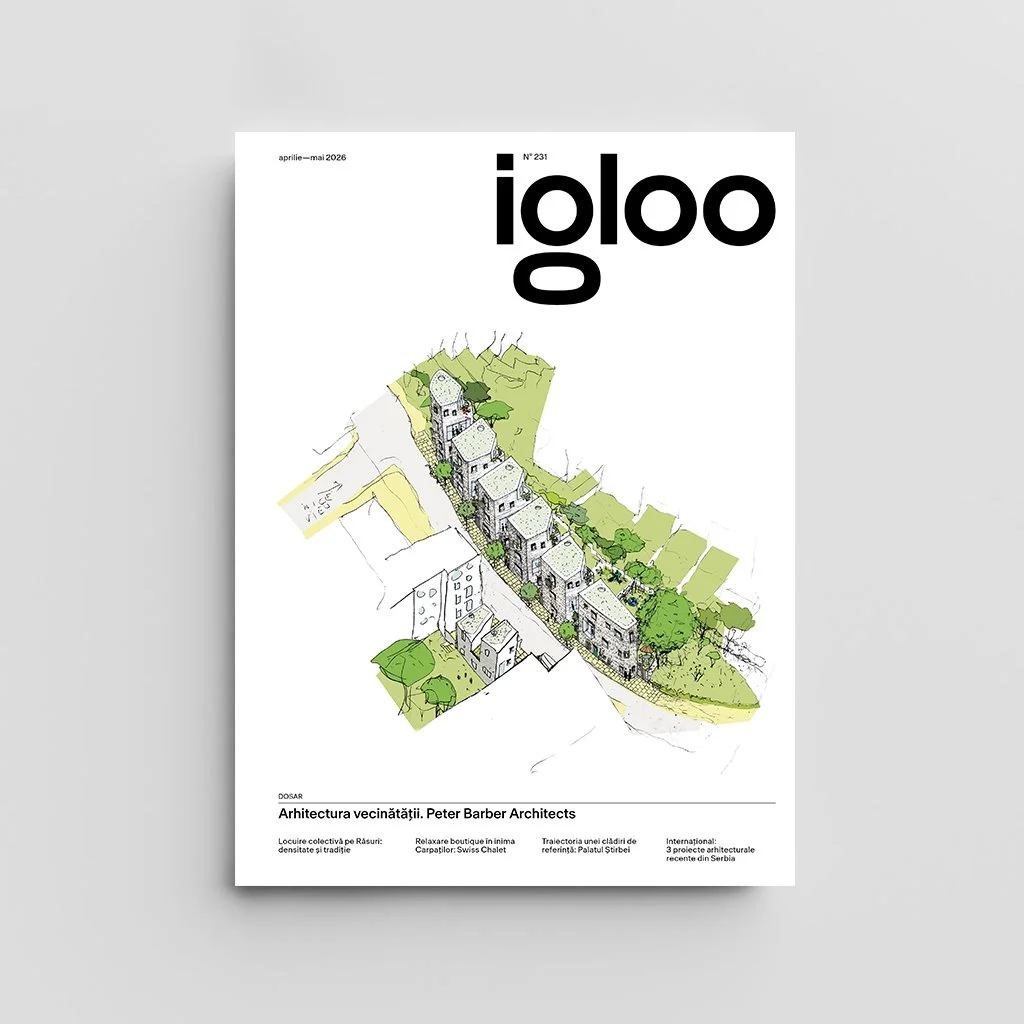
INTERVIEW WITH PHIL HAMILTON
igloo Magazine Issue no. 231, Written by Anda Zota, April 2026
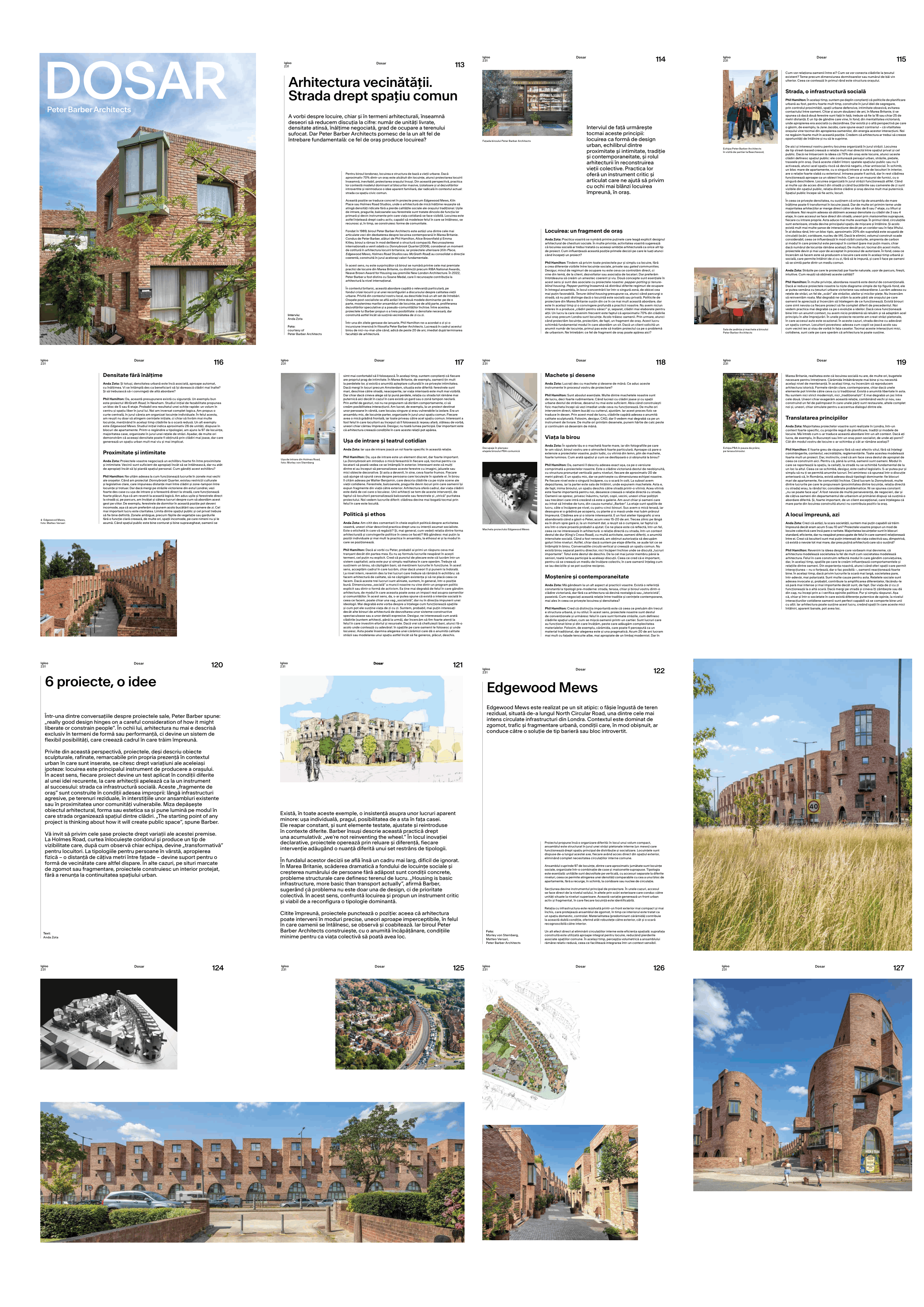
Designing Neighborliness: The Street as Architecture
Peter Barber Architects
Interview: Anda Zota
Today, housing is usually reduced to numbers: units delivered, density achieved, height negotiated. Yet Peter Barber Architects insist on a more fundamental question: what kind of city does housing produce?
For the London-based practice, housing is the primary substance of urban life. If roughly 70% of a city is made of homes, then designing housing inevitably means designing the city itself. Their projects challenge the prevailing model of large apartment blocks and inward-looking developments by reintroducing an older but surprisingly radical idea: the street as a shared civic space.
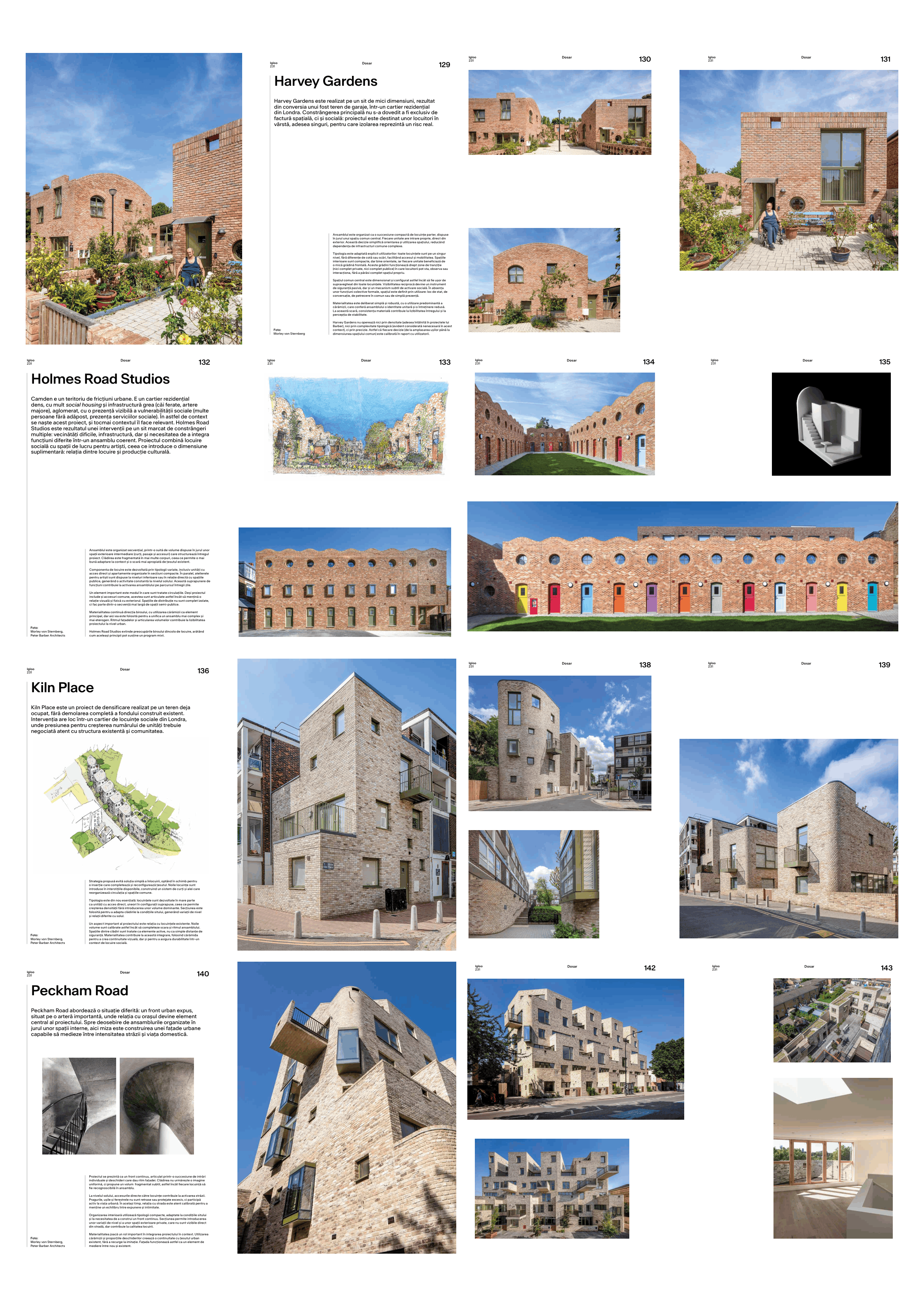
Across projects such as Edgewood Mews, Kiln Place or Holmes Road Studios, Barber’s work explores how relatively low-rise buildings can achieve high density while preserving the social qualities traditionally associated with streets, terraces and mews. Front doors, thresholds, balconies and windows become architectural instruments through which everyday social life unfolds. The practice approaches housing as a social framework, one capable of shaping how people meet, recognize and care for one another.
Founded in 1989, Peter Barber Architects has become one of the most distinctive voices in the debate on contemporary housing in the United Kingdom. Led by Peter Barber together with directors Phil Hamilton, Alice Brownfield, associate director Emma Kitley, and colleagues within the practice, the studio kept a small and compact team thorough the years. The practice first gained international attention with Donnybrook Quarter (2006), a project widely regarded as a turning point in contemporary British housing design. Since then, schemes such as Kiln Place, Edgewood Mews, Holmes Road Studios or McGrath Road have expanded this research, encompassing a coherent, structured body of works. Central to the practice’s ethos is the belief that architecture can actively support social interaction without imposing it. Their projects often replace internal corridors and lifts with direct access from the street, multiplying front doors and creating spaces where daily life unfolds visibly. The street overcomes its role of infrastructure, reading as a shared civic room, where children play, neighbors greet each other and the rhythms of domestic life animate the city.
No wonder they’re the most awarded housing practices in the UK, receiving RIBA National Awards, the Neave Brown Award for Housing, and multiple New London Architecture prizes. In 2022, architect Peter Barber was awarded the prestigious Soane Medal, recognizing his contribution to architecture at an international level.
In the British context, this approach has gained particular significance in recent decades, as the country faces an acute housing shortage and a renewed debate about the quality of urban living. By proposing alternatives to both high-rise towers and suburban sprawl, Peter Barber Architects have contributed to a broader rethinking of housing typologies in the UK.
In our local eyes, their work resonates with another set of questions. Many post-socialist cities are currently navigating the legacy of large housing estates while confronting the rapid emergence of gated communities and speculative apartment blocks. Between these two models, Barber’s work suggests a third possibility: density, but encouraging everyday neighborliness.
The following conversation explores the principles behind this approach, discussing housing as urban design, the delicate balance between proximity and privacy, and the role architecture can play in rebuilding collective life in contemporary cities.
Housing as a Piece of the City
Anda Zota: Your practice is among the few that openly link architectural design with social questions. In many ways, your work suggests that social housing should be treated with the same architectural ambition as any other building type. How does that belief shape the earliest decisions you make when starting a project?
Phil Hamilton: We tend to think about projects simply as housing, and not create visible differences between social, private or rental. Of course, the mix of tenures is not something we control directly. It comes from the brief, from the client, the developer or the housing association. But our preference is always to create a strong mixture, not to separate tenures across the site. Two ideas are central to this, and often linked to our projects: pepper-potting and tenure-blind housing. Pepper-potting means distributing different tenures throughout a development instead of clustering them in one area, often the least desirable part of the site. And tenure-blind housing means that, when you walk down a street, you shouldn’t be able to tell whether a home is social housing or private. Planning policy in the UK increasingly supports this approach, but it’s also something we believe in very strongly. We have no interest in producing „poor building for poor people” and a more elaborate one for others. A statistic we often return to is that roughly 70% of buildings in a city like London are housing. That’s where people live. So when we design a housing project, we are effectively designing a piece of the city. That fundamentally changes how we approach a site. If a client asks for a certain number of homes, the first thing we do is treat the project as an urban design problem. We ask: what kind of piece of city could exist here? How will people relate to one another? How will the buildings connect to the surrounding fabric? Questions like bedroom sizes or the number of bathrooms come later. What comes first is the structure of the city.
The Street as Social Infrastructure
Phil Hamilton: At the same time, we are very aware that planning policy has historically been shaped by a desire to separate and control proximity, ideas of defensible space, privacy, and preventing people from seeing or encountering one another. Even twenty years ago, planners in the UK would insist that if two windows faced each other, they had to be eighteen or twenty-five meters apart. Much of this thinking goes back to Victorian attitudes, where proximity was associated with disorder. But thinkers like Jane Jacobs argued the opposite: that the vitality of cities comes precisely from people being close to one another, from the energy of interaction. We strongly align with that position. We believe architecture should encourage opportunities for interaction, not suppress them. That is where our interest in street-based housing comes from. Street-based housing creates a strong relationship between the private and the public realm. If we think again about that 70% of the city that is housing, those buildings are forming the edges of public space, they define streets, squares, and the way people move through the city. If those buildings turn their backs on public space, or fail to activate it, then that space can become negative or even antisocial. By contrast, a typical large apartment block, with a single entrance and hundreds of residents inside, has a very weak relationship with the outside. The entrance might be active, but beyond that it behaves almost like a sealed object. It’s a bit like an anthill with a single opening. Street-based housing works very differently. When you have many front doors along the street, and when kitchens and living spaces are visible from the public realm, you create a much stronger connection between the building and the city. The public space becomes active. In terms of density, we’re not suggesting that every high-rise scheme can be turned into low-rise housing. But in many cases, we are given densities where most architects would default to a six- or seven-story block of flats with lifts and corridors. We often manage to achieve the same density with three- or four-story buildings, where people enter directly from the street, sometimes through stacked maisonettes with individual access points. There are several advantages to this. First, all the circulation is externalized, so the street becomes the primary space of movement and encounter. We believe there is a greater chance of social interaction there than in a corridor or lift lobby. Second, in a typical apartment building, around 20% of the floor area is circulation (stairs, corridors, lift cores). If you remove that, you reduce the overall building volume significantly. That has benefits in terms of cost, carbon, and the perceived scale of the development within its context. It also tends to make projects more acceptable in planning terms, because they appear less dense, even if the number of homes is the same. Ultimately, what we are trying to do is create housing that is both urban and social, that supports everyday encounters without forcing them, and that allows people to feel part of a shared environment rather than isolated within it.
Density Without Height
Anda Zota: Yet height is still widely associated with density. Do clients often expect taller buildings, and do you have to convince them otherwise?
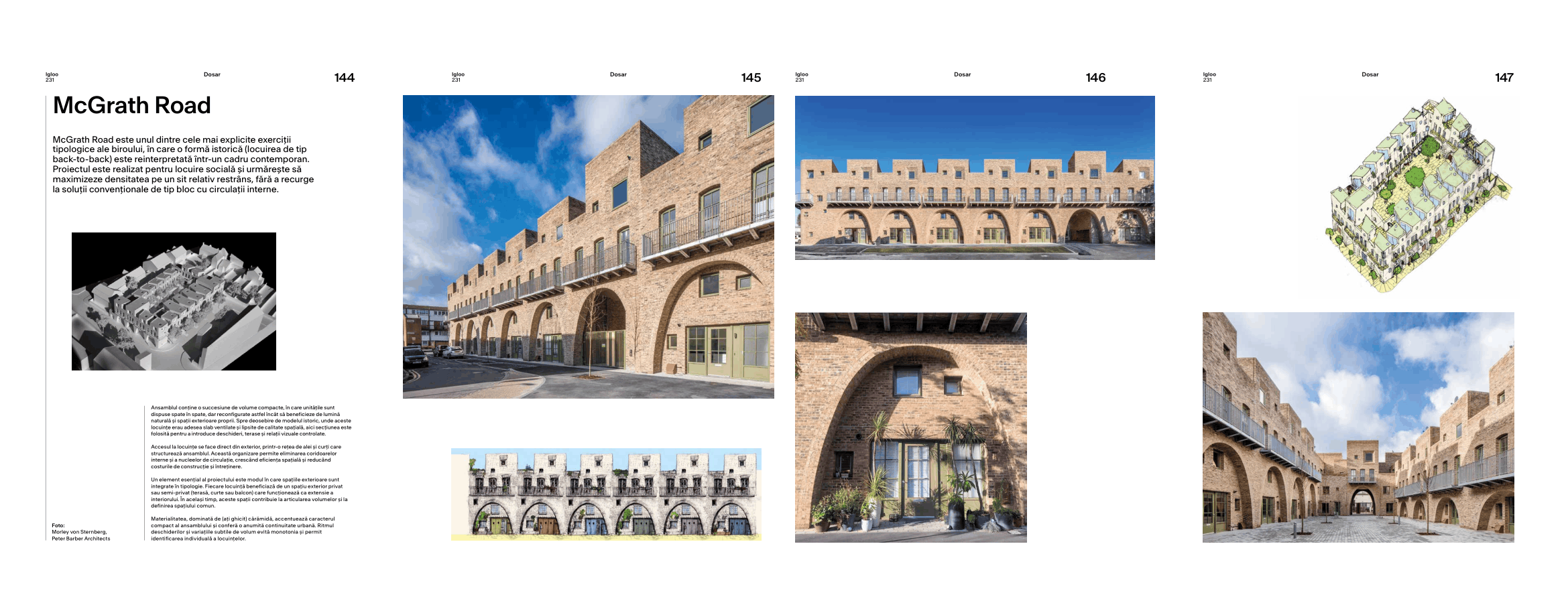
Phil Hamilton: Yes, that assumption certainly exists. A good example is McGrath Road in Newham. The initial feasibility study assumed a five- or six-story apartment block sitting in the middle of the site. That approach probably came from a quick sketch, placing a block in the center and leaving space around it. Instead, we inverted the strategy. We created a courtyard at the center of the site and surrounded it with houses. In doing so we actually delivered more homes than the brief required, while keeping the buildings relatively low. Another example is Edgewood Mews. The original study suggested around twenty-six homes in a series of apartment blocks. By rethinking the typology we achieved ninety-seven homes, mostly houses, arranged around a network of streets. So very often we demonstrate that the same density can be achieved with lower buildings that create more engaging urban spaces.
Proximity and Privacy
Anda Zota: Your projects negotiate a careful balance between proximity and privacy. Neighbors are close enough to encounter one another, but not so close that intimacy is lost. How do you approach that balance?
Phil Hamilton: We often look at how things work in older parts of cities. When we designed Donnybrook Quarter, there was a strong planning culture insisting on large distances between buildings and a buffer between houses and the pavement. But if you walk through Victorian streets in East London, many houses have a front door and a window directly onto the pavement, and those places work extremely well socially. So we returned to that idea. We placed front doors and windows directly on the street and learned some lessons along the way. For instance, placing bedroom windows there can sometimes feel uncomfortable, so now we often replace them with kitchens or living spaces. What matters most is clarity. The boundary between public and private space should be clearly defined. Ambiguous strips of landscaping or railings often create awkward spaces that no one really claims. When public space is well defined and well overlooked, people feel more comfortable occupying it.
At the same time, we recognize that people have different thresholds for privacy. In the UK, for example, people tend to like their net curtains. There’s a cultural expectation of privacy. If you go to somewhere like Amsterdam, people are much more open, with large windows showing off directly onto the street. But that’s fine. Even if someone chooses to put up curtains, the relationship to the street is still stronger than if there’s a fence or an undefined strip of land in between. Hence, we don’t dictate, yet we’re trying to create the possibility for interaction. We did a project for older residents, people who were living alone and potentially quite vulnerable to loneliness. It was a small scheme of single-story homes arranged around a shared space. Each house had a small front garden, and the only outlook was into that shared space. What was really interesting was how the residents started using it: sitting outside, talking to each other, sometimes even singing together. Not everyone participates, of course, but the important thing is that the architecture creates the conditions for those relationships to form.
The Front Door and Everyday Theatre
Anda Zota: And the front door seems to play a very specific role in that.
Phil Hamilton: Yes, the front door is quite a subtle but important element. At Donnybrook we placed a small window in each front door so residents could see what was happening outside. Interestingly, many people personalized those windows, adding pictures, blinds or decorations.
That became quite beautiful in itself. Each door expressed something about the person living behind it. We often refer to Walter Benjamin, who described buildings as stages for everyday life. Windows, balconies and thresholds allow people to present aspects of their lives to the outside world. Architecture provides the framework, but the life of the building comes from the residents themselves. Some architects worry when people personalize balconies or windows, because it disrupts the purity of the design. We tend to see it differently: the building becomes richer through occupation.
Politics, Ethos and the Practice
Anda Zota: I’ve come across quite a few readings of your work that frame it in explicitly political terms, sometimes even describing the practice as having openly socialist intentions. Is that something you recognize? And more generally, how do you see the relationship between architectural form and political conviction in your work? I’m thinking less about individual positions and more about the practice as a whole, its ethos, the way it positions itself.
Phil Hamilton: If you were speaking to Peter, you might get a slightly stronger answer on that front than from me. I wouldn’t necessarily describe it in those terms, at least not explicitly. I suppose the starting point is that we operate within a capitalist system; that’s simply the reality of the environment we work in. We have to run a practice, earn money, keep things going. So in that sense, we accept the framework we’re working within, even if we might question aspects of it. Internally, we often talk about three things that need to be in balance: doing good architecture, earning a living, and enjoying the work. If those three are aligned, then we’re generally in a good place. The „social” dimension of what we do doesn’t come from a kind of overt political agenda or activism. It’s more embedded in the way we think about architecture, how it can benefit people and communities. So in that sense, yes, you could describe it as having a social intention, perhaps even a loosely „socialist” one, but not trying to impose an ideology. We’re probably less interested than some practices in architecture as a purely formal or technical exercise, in developing new construction systems or expressive details for their own sake. Of course, we care about how buildings look (we are architects, after all), but we try to be quite careful about where effort and resources are invested. If you’re going to spend money, spend it where it matters, in the spaces people inhabit. That might mean choosing a brick that gives a certain quality to the street, or shaping a space so that it feels generous or uplifting.
Designing Streets That Feel Natural
Anda Zota: Your streets feel natural, walkable. How do you achieve that quality?
Phil Hamilton: In many ways our approach is quite conventional. If you reduced our projects to simple figure-ground diagrams, they might resemble Victorian or Edwardian street patterns. We often design ladders of streets or networks of lanes and small squares. We are not trying to reinvent the wheel. Instead we look at parts of cities that people love and ask why they work. Some architecture practices feel every project must be radically different from the previous one. We see our work as an evolution of ideas. If something works well in one context, we are not afraid to use it again elsewhere. In some recent projects we have created pedestrian streets where cars enter only occasionally. In those cases, the street becomes a truly shared space. Residents often describe how children play there or neighbors gather outside. These small everyday interactions are exactly what we hope the architecture can support.
Models, Drawing and Craft
Anda Zota: Your studio seems deeply invested in physical models and hand drawing. What do these tools bring to your design process?
Phil Hamilton: They are absolutely essential. Many of our models are very rough working models. When you work with relatively low buildings and tight urban spaces, drawings alone are not enough. By building a physical model you can immediately see when something doesn’t feel right. Often we cut pieces away from a model with a knife to adjust the geometry. That physical process feeds back into the drawings. Because of that method, the buildings often develop a sculptural quality. The forms emerge from physically shaping space and not from digital modelling. We do use CAD, of course, but we see it primarily as a delivery tool. Very often we print drawings, place tracing paper over them and continue designing by hand. Hand drawing keeps ideas open. Digital images can sometimes fix a design too early.
Anda Zota: You’re speaking with a large model behind you, and I’ve seen images of your office, it has a very particular atmosphere. It almost feels like an extension of your projects: quite whimsical, with the wooden façade, the models, the light. Could you describe the space a bit and what a typical day in the office looks like?
Phil Hamilton: People often come in and say exactly that, that the office feels like a sort of architectural version of one of our projects. It’s a slightly odd little Victorian building. Not that our architecture is Victorian, but the structure itself is very vertical: four storeys, with each floor only about twenty square meters. So it’s quite small, which suits us because we’re a small team. Each floor is essentially a single room with a stair in the corner. There’s a basement where we keep all the storage, and then on the ground floor we have the meeting room, which also doubles as the model room. That’s really the heart of the office, and it opens onto the street through a shop window. That shopfront is something we really value. It creates a direct relationship with the street, where people stop and look in all the time. You get all sorts: tourists, kids, people from the neighborhood, sometimes even police or passers-by who just wander in thinking it’s a gallery. We’ve even had people come in asking for a haircut because of the name „Barber”. Upstairs, the next two floors are workspaces: again, one room each, with four or five desks. Then at the top there’s a small terrace, and above that a roof terrace with plants and a table where we can sit and have lunch together. The building itself has a bit of a history. It used to be a print work, and it was derelict when Pete found it, about fifteen or twenty years ago. He used to walk past it on his way to the station and eventually managed to acquire it. Being derelict probably helped. What we like about it is that it does, in a way, reflect what we’re interested in architecturally: it has a very direct relationship with the street, and it sits on quite a tough part of King’s Cross Road, with a lot of activity, a mix of people, quite a lot of social intensity. So there’s always a sense of engagement with what’s happening outside. When Pete renovated the building, we managed to get permission to cut openings through the floors. So even though we’re on different levels, you can still hear what’s going on across the office. Conversations travel between floors, and that creates a kind of shared environment. There’s no separate office for the director, no closed rooms where certain conversations happen privately. Everything is quite open. From the most junior member of the team to the most senior, everyone hears the same discussions. I think that’s important. It creates a kind of collective learning environment, where people pick things up, understand how decisions are made, and they can support each other when things are difficult.
Anda Zota: There’s something I’ve been thinking about in your work. It often references, in one way or another, pre-modern housing traditions, whether it’s the street, the terrace, or even your own office in a Victorian building. But at the same time, it never feels nostalgic or historicist. So how do you negotiate that relationship between tradition and the demands of contemporary living, especially in terms of welfare and density?
Phil Hamilton: I think the important distinction is that what we borrow from the past is primarily urban structure, and not necessarily the style. In that sense, our work is actually quite conventional in terms of how streets are formed, how buildings define space, how people move through a neighborhood. Those are things that have worked well historically, and we’re quite happy to learn from them. Where it becomes more complex is in terms of appearance and materials. We do use materials that might be considered traditional (brick, for example), although partly that comes from very practical considerations. Twenty years ago, we were doing more white rendered buildings, which were perhaps more aligned with a kind of modernist language. But in the UK, the reality is that social housing often doesn’t have the maintenance budgets required to keep those buildings looking good over time, so we turned to brick. At the same time, we’re not trying to reproduce historical architecture. The forms are still quite crisp and contemporary, even if some of the elements might reference something more traditional. And I think there’s a certain freedom in that. We’re not strictly modernist, but we’re not traditionalists either. There’s a kind of play between the two. Sometimes we even exaggerate combining old and new, or creating a sort of patchwork where parts are restored, parts are new, and occasionally even parts are deliberately „faked” to reinforce that dialogue.
Housing, Policy and Collective Life
Anda Zota: Do you think people today are less capable of living collectively than they were in the past?
Phil Hamilton: I actually think the opposite. Architecture can influence society just as much as society influences architecture. When housing is arranged in ways that encourage interaction, when streets and shared spaces are carefully designed, people tend to respond positively. Residents in many of our projects tell us they know their neighbors far better than they did in previous homes. The spatial arrangement creates opportunities for interaction. Of course, contemporary society sometimes feels polarized, and social media can amplify disagreements. But everyday life still contains countless small encounters, like greeting someone in the street, exchanging a few words with a neighbor. Architecture can support those moments.
Translating Principles
Anda Zota: Most of your work is rooted in London, with all its specific constraints (planning systems, traditions, policies and housing models). I’m curious how you imagine your approach translating elsewhere. If you were to work in Bucharest, or in a post-socialist context more generally, what would you start from? How much would your design change, and how much would remain the same?
Phil Hamilton: It’s very difficult to answer that without actually seeing the site, understanding the constraints, the context, what’s adjacent, what the regulations are. Those things shape a project enormously. But instinctively, I suspect we would try to do something quite similar to what we do here. Because, at the end of the day, people are people. The way people relate to space, to each other, to the street, those things don’t fundamentally change from one place to another. What does change, of course, is the regulatory environment. You might simply not be allowed to do certain things. I remember you mentioned in a previous conversation that in Romania there’s often a default towards either large apartment blocks or gated communities. In the UK, when we were working on Donnybrook, many of the things we were proposing (the proximity between homes, the relationship to the street) were also seen as problematic. We were constantly told: you can’t do that. It took a lot of persistence, a lot of negotiation, and also a few people within the planning system who were willing to support something different. And an exceptional client who understood that much of the housing being built at the time wasn’t contributing positively to the city.
On Collective Living
Anda Zota: Do you feel that we’ve become less capable of living collectively compared to, say, five or ten years ago? I’m thinking about this more broadly, at the scale of society. Your projects seem to propose a certain way of living together that is still relatively rare. Most housing today is reduced to standard apartment blocks, efficient, but not necessarily concerned with how people actually relate to one another. So do you think people are less interested in collective living, or on the contrary, that there’s a growing need for it and simply not enough architecture that supports it?
Phil Hamilton: I think it goes back to something we touched on earlier, this idea that architecture shapes society just as much as society shapes architecture. The way we build reflects how we think about living together, but at the same time, the spaces we create also influence how people behave and relate to one another. From our experience, when you provide spaces that allow for interaction (not force it but make it possible) people respond very positively. You hear it again and again from residents: I know my neighbors here in a way I didn’t before. That’s a very common response. So I don’t think it’s that only a certain type of person can live in these environments. It’s more that the spaces themselves encourage a different kind of behavior, a more open, more sociable way of living. If you design for that, people tend to embrace it. At the same time, if you step back and look at society more broadly, it does feel quite polarized at the moment. There are all sorts of reasons for that: social media is often cited, and it probably does play a role in amplifying differences, making disagreements feel more immediate and more significant than they might otherwise be. But I think it’s important to remember that everyday life still operates at a different scale. If you’re walking down the street and someone nods or smiles at you, you don’t first check what their political opinions are. You just respond. So even in a society where people may disagree quite strongly at a distance, at the level of everyday interaction, people are still perfectly capable of behaving positively towards one another. And I think architecture can support that. by creating spaces where those small, ordinary interactions can happen.